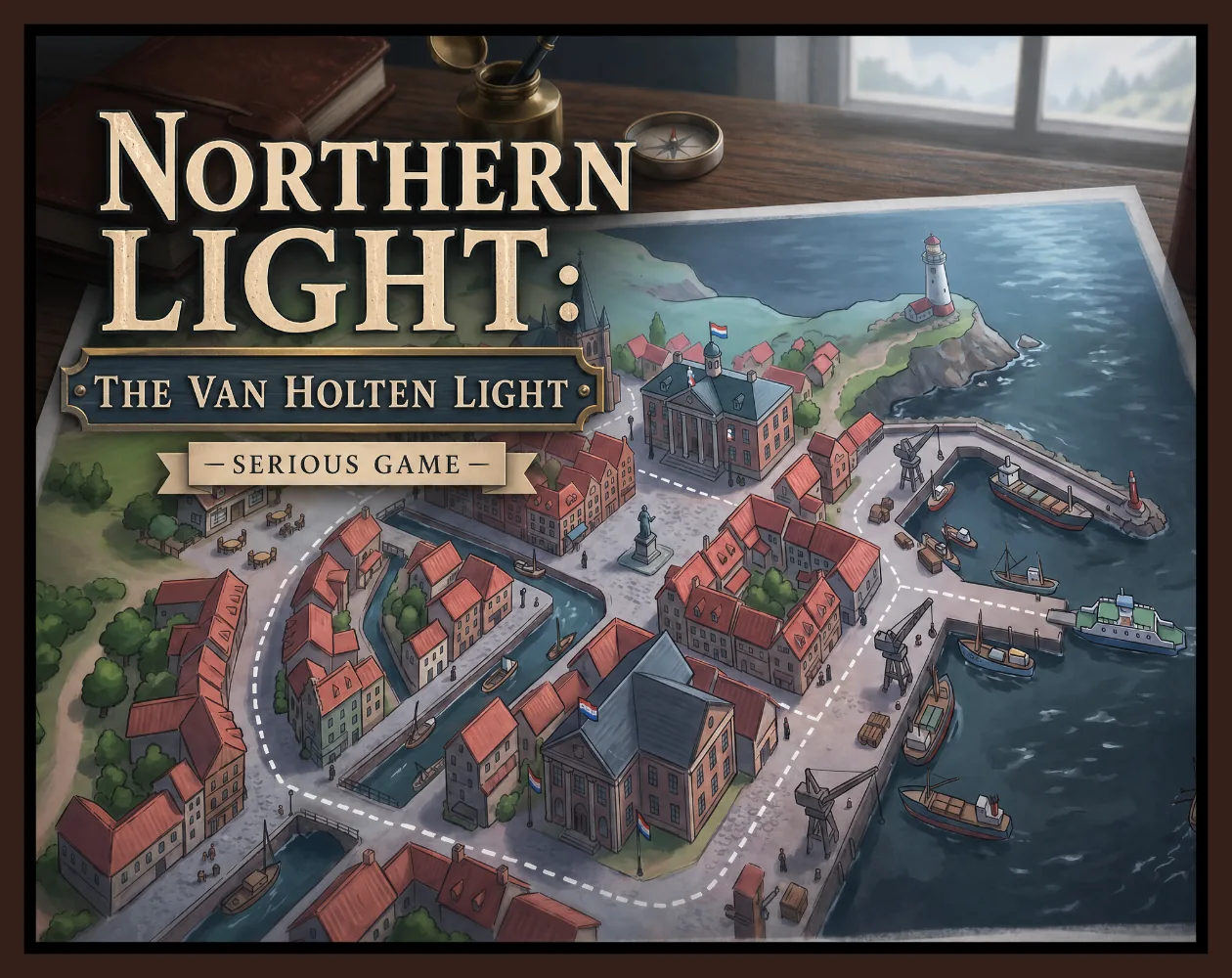
A serious game about workplace judgment. You play a junior analyst at a Dutch ministry, given a single file: should a 1885 lighthouse stay manned, partially automate, or switch to sensors only? The answer isn’t in the brief. It’s in the keeper, the union rep, the harbour master, the tourism board, and the model you build from what they tell you.
Beta. Playable end-to-end; polish in progress. Built as the proving-ground example for Scenario Studio — the example matters here, not the tool.
The premise
Marieke, two years on the job, first solo file. Five stakeholders, each with skin in the game, each with information you need. A model to build. A council hearing where you’ll defend it.
The recommendation is yours. The responsibility is the minister’s. He reads the appendix.
What you actually do
You walk through six locations in any order — ministry office, harbour, keeper’s cottage, union hall, tourism board, council chamber — collecting evidence as you go. A logbook hidden in the cottage. A 1980s radio terminal you query for incident records. A heritage-grant clause buried in §4.2 that reverses your conclusion if you miss it. A union pilot postmortem that reframes the cost of automation.
Every piece of fieldwork unlocks a cell in a live spreadsheet model — Net Present Value, Net Social Benefit-Cost ratio, twenty-year horizon. The model is the spine of the game. Most of it starts locked, and stays locked, until you do the work.
Then the council hearing. Five stakeholders take turns challenging your numbers. The keeper points at his 34 dead-zone incidents. The union rep quotes labour-transition data the vendor didn’t share. The tourism director tests whether you spotted the heritage grant condition. Get an answer right and your credibility holds. Miss something and the room turns.
Why I built it this way
Workplace training mostly treats decisions as multiple-choice quizzes. Pick one of three. Green tick or red tick. Move on.
That doesn’t teach judgment, because that isn’t how judgment works. The interesting part of any real decision is which evidence you trusted, who you pushed back on, what you missed because you didn’t ask, and whether you can defend your answer to the people most affected by it.
Northern Light is the bet that giving learners real agency in a branching scenario teaches the underlying skill in a way slide decks can’t. You can fail. The fail isn’t a wrong-answer screen — it’s the keeper looking past you at the minister. You can take three different defensible paths and produce three different defensible answers. You learn that defensibility, not correctness, is the actual deliverable.
For an L&D audience, this is the hill: serious games for judgment work, when you build them with proper agency, beat traditional courseware on the things that matter — transfer to the job, retention, the willingness to make a real call.
The combination
What makes this build interesting isn’t any one piece. It’s the way they fit:
- Godot 4 for a real-feeling game, not a slideware sim — branching dialogue, state-rich systems, a custom spreadsheet minigame that recalculates live.
- AI-generated character art for every face in the cast, prompted and curated to land specific emotional registers. The art was generated; the casting — who these people are, what they want, how they push back — is mine.
- SCORM 1.2 export out of Godot, so the same game that runs on itch.io in a browser drops as a ZIP into any corporate LMS. Completion and score sync without a code change.
- Authored, not coded. The whole scenario is composed from data resources you can edit in a form-based UI. Designed to be picked up and re-skinned by other instructional designers.
That four-way combination — game engine + generative art + LMS-deliverable runtime + designer-friendly authoring — isn’t usually in one person’s stack. It is, here, because it had to be.
What’s next
Beta means: the loop is fully playable, but I have a list. Voice acting on the council scene. Localization (Dutch + English to start). A second axis of stakeholder trust that unlocks optional council moves — turning the final act from a quiz into a negotiation. Replay wrap-up showing what evidence you missed. Accessibility pass.
Playable now in your browser on itch: Northern Light: The Van Holten Light →. If you play and something lands — or something doesn’t — tell me. Beta means I’m still building, and the right notes from the right players reshape the next pass.