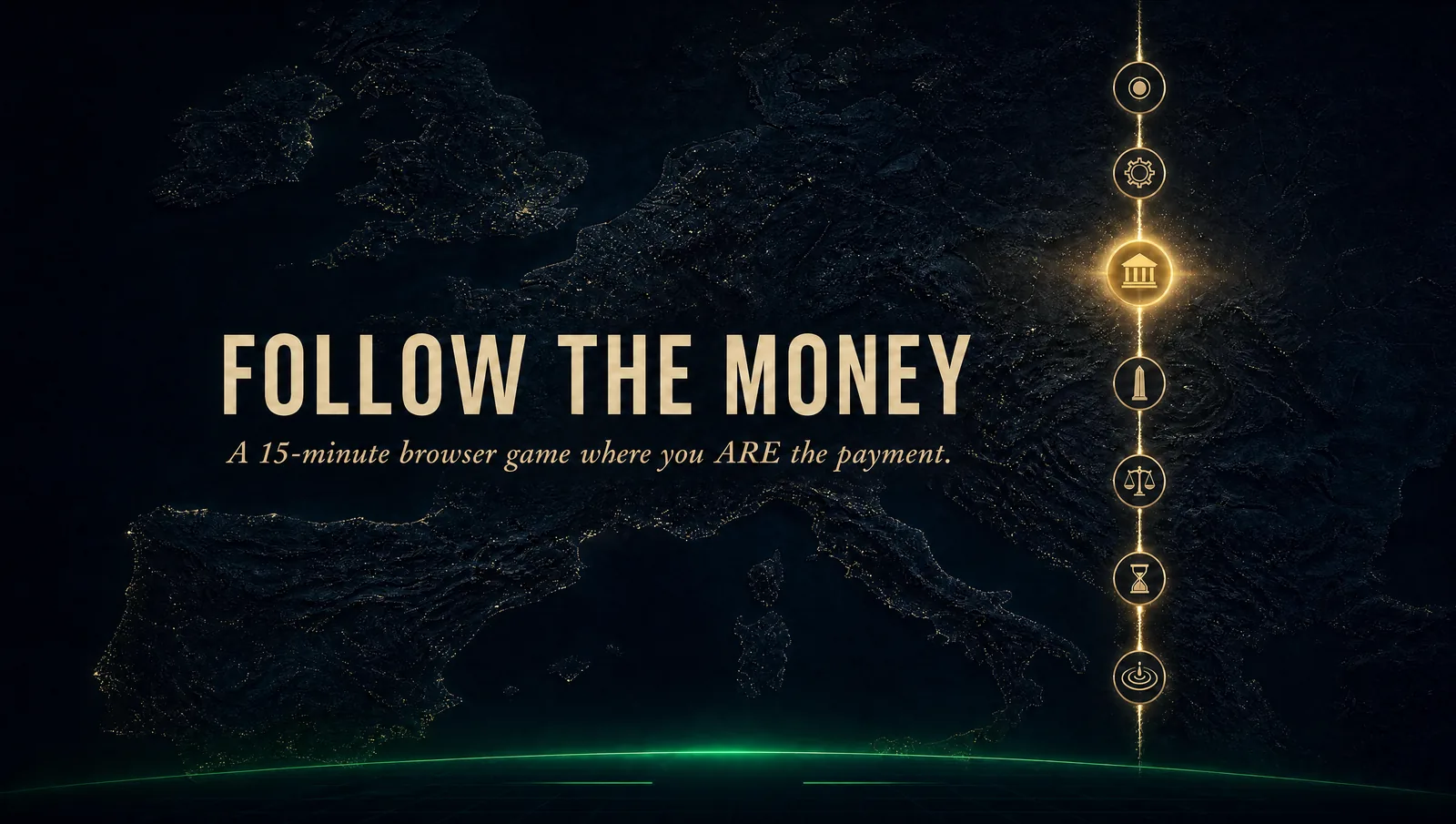
A 15-minute browser game about how a card payment actually moves through Adyen. Seven stops. Three scenarios. One short ride through the system that moves your money. The first episode of European Tech, Played — a series of serious games about the European tech companies most people only know by name.
Active. Episode 1 shipped; Episode 2 (Follow the Chip — ASML) in production. Vanilla HTML/CSS/JS, no framework, no build step. Self-hosted at bojansavic.com so the case file and the playable are one continuous surface.
The premise — you ARE the payment
Most lessons about payment systems are diagrams. Arrows between boxes. You see them, you nod, you forget.
This flips the angle. You don’t observe the system — you BECOME a unit of it. You’re a single €127 payment born when Marlene taps her card at a leather workshop in Kreuzberg on a Monday evening. Over the next fifteen minutes you move through Adyen’s seven-stop processing cycle: a gateway that validates your shape, a risk engine that reads you for fraud, the card schemes that take their cut, the issuer’s bench that decides whether you’re allowed at all, a capture window where the merchant decides when to actually move the money, and finally settlement — where you dissolve into the merchant’s account, minus the toll.
Three scenarios, three different lessons:
- First Payment — the canonical domestic cycle. Marlene buys leather gloves; the basic shape of every card payment.
- Cross-Border — you are Camila in São Paulo, buying a vintage guitar from Brooklyn. The lesson is local acquiring: why the same payment can sit at a 30–40% approval rate or an 80–85% approval rate depending on which country code is on the acquirer. The geography is the moat.
- Marketplace — you become Sofía, founder of an artisan platform splitting a single basket across three sellers. The lesson is Balance Accounts, split capture, and why platforms are routing problems pretending to be transactions.
The seven stops
| Stop | Biome | What you do | What it teaches |
|---|
| 1 | The Café | Tap the terminal | A payment is born from a want |
| 2 | The Foundry (Gateway) | Place 7 card fields into slots before a timer ends | PAN / EXPIRY / CVV — the shape the network reads |
| 3 | The Customs House (Risk Engine) | Pick a posture; judge three intents at a slab | False decline vs missed fraud — every block has a cost |
| 4 | The Plain of Tolls (Card Network) | Pass through. No agency. | Adyen does not own the schemes — Visa and Mastercard take their share regardless |
| 5 | The Court (Issuer Authorization) | Play evidence cards against a hidden threshold | History is your only argument; the issuer’s “yes” is the only “yes” that matters |
| 6 | The Waiting Room (Capture) | Choose when to capture across a 7-day window | Authorized is a promise; captured is the move. Auth lapses on day 7 |
| 7 | The Tide (Settlement) | Dissolve into the merchant’s account | The full run is summarized. The cycle remembers. |
The centerpiece is the Court. It’s where the lesson “the bank decides, not the merchant, not Adyen” gets felt rather than told. You hold a hand of five real signals — Network Token, 3DS2 authentication, AVS match, Merchant History, Low Velocity — each with a strength value and a synergy graph. You play up to three, watch a meter, decide whether to spend your Smart Retry. The threshold is hidden, computed from everything you did at Customs, every error you made at the Foundry, every minute of friction the system has accrued against you. Win and the magistrate’s bench rises. Lose and the seal is withheld.
The Court is where players consistently say “oh — I get it now.”
Why Adyen — and why now
Three reasons it’s Episode 1.
Adyen is the quietest interesting company in European tech. A Dutch payment platform that processes a meaningful share of the world’s biggest merchants — Uber, H&M, eBay, Spotify, Microsoft — and most Europeans interact with it daily without noticing. The discipline behind that invisibility is worth a fifteen-minute tour.
It sits at a politically loaded moment for European digital sovereignty. PSD3, the Digital Euro, MiCA, the Data Act. Adyen holds its own banking licenses in 40+ markets. Their commercial moat is regulatory labor — geography pretending to be product. If you want to understand where European tech is going, this is the kind of company to look at first.
And payments are the most concentrated example of “follow the money” as a lens. Whose ledger holds it? Whose risk model approves it? Whose terms govern when it’s released? Who eats the loss when something goes wrong? Payments are where institutional trust gets manufactured in real time.
Agency IS the lesson
Most serious-game design starts with content and asks “how do I gamify this?” That produces flashcards with progress bars. I started with a different question: what kind of decision IS this?
A payment is four different kinds of decision stacked on top of each other:
- Moment-to-moment — Foundry: speed + accuracy under a 15-second timer
- Strategic — Customs: pick a posture, live with it across three transactions
- Narrative — Court: your evidence compounds with everything that came before
- World — Tide: everything you did is now visible, summarized, written to the Ledger
These four map exactly to the Four Agency Types framework — the design vocabulary I’ve been refining across the last decade of serious-game work. The curriculum IS the controls. That’s not a metaphor; the seven biomes are a direct demonstration of the framework, applied to a payment cycle.
The build is held together by four pillars I check every design decision against:
- Teach by feeling, not telling. Interchange fees appear as HUD deductions, not tooltips. The cost is felt before it’s named.
- Agency IS the lesson. What you choose IS the curriculum.
- The cycle is the world. The seven biomes ARE the seven real stops in Adyen’s processing cycle.
- Earned, not given. The dossier — the post-run shareable artifact with three pages on the four-party model, local acquiring, and Adyen for Platforms — unlocks one page per scenario completed.
The Three Voices
Most serious games have one voice. A teacher’s voice, helpful, neutral. Follow the Money has three (sometimes six), and they argue with each other.
- The Narrator speaks ABOUT humanity — anthropological, dry. Pale violet, top of screen.
- The System speaks TO the Intent in declarative simple sentences. “You are a packet now.” Packet-blue, bottom.
- The Schema is precise and cold. Mono caps, right margin. Reads signals, names fields.
- The Pulse is warm and anxious. Italic serif, left margin. Worries about the human in the café.
- The Toll is older than everything. Red-orange, resentful. Knows what it’s owed.
- The Shadow awakens only after you’ve earned enough trust across runs. Quiet, knowing.
The argument IS the curriculum. When Schema names a fraud signal and Pulse pleads “but she’s just a regular shopper,” the player learns that fraud risk isn’t a math problem — it’s a tension between two correct things. Disco Elysium taught me this years ago; it’s the load-bearing trick.
The whole thing is voiced. ~200 lines across the three scenarios, cloned through Chatterbox and post-produced. Voices play serially through a global queue with priority tiers so they never overlap. The player just hears focus and rhythm.
The aesthetic — what it isn’t
Follow the Money is not pixel art. It is not cartoon. It is not 3D. It is text and geometry and confident silence. Touchstones, named honestly: Disco Elysium (text as mechanic), Mirror’s Edge (geometric minimalism), Kentucky Route Zero (theatrical pacing), Inside (the screen waits for you).
Vanilla HTML/CSS/JS — no framework, no bundler, no build step. The constraint is the design. Depth comes from prose and pacing, not Webpack.
The biomes treat the payment cycle as a journey through institutions, not a UI flow. Chapter cards read like train-station announcements. The Court is wood-warm and intimate. The Customs House is cold bureaucratic blue with SVG-line architecture. The Plain of Tolls is a salt-flat at dusk where monoliths take their cut. The Waiting Room has a clock and a seven-day cadence you can hear ticking. The Tide is a teal pool where the payment dissolves and the dashboard rises.
What’s next in the series
Episode 2 — Follow the Chip — is locked as ASML. Same format, same fifteen-minute commitment, different protagonist. You’ll be a chip moving through ASML’s design-to-lithography-to-manufacturing cycle. EUV machines, photoresist, the quiet politics of who gets allocated the next generation of lithography. After ASML: probably Follow the Remittance (Wise), then Follow the Instalment (Klarna), then a wildcard — possibly Bolt, Yara, or DSV. The format is portable. Any system with a clear cycle and a load-bearing protagonist-as-unit metaphor can become a 15-minute first-person tour.
Got a candidate for a future episode, or just want to nerd out about which company should be next? Reach out.
Tech
- Stack — vanilla HTML, CSS, JavaScript. No framework, no bundler, no build step.
- Audio — ~200 voice lines, voice-cloned through Chatterbox, post-produced. Global serial queue with priority tiers — voices never overlap.
- Architecture — modular ES6 across 32 source files; one engine layer (audio queue, narrative arbiter, dossier state) and per-episode biome implementations.
- Hosting — self-hosted at
bojansavic.com/follow-the-money/, served from nginx via an aliased location block. Independent deploy lifecycle from the main site.
- Audience signal — designed for L&D and learning-experience-design peers who can read mechanics as a portfolio of decisions, but playable cold by anyone who’s ever tapped a card.
Status
Episode 1 shipped end-to-end. Three scenarios fully playable, the Court arc working as the centrepiece, voice acting in. Episode 2 (ASML) in design. Series-level questions: can Europe build what it depends on? Can Europe move what it depends on? Can Europe trust the systems it depends on? — different angles per episode.