Case File · 001 Active
Scenario Studio
A serious-game authoring tool and SCORM-ready runtime for workplace training — built in Godot 4.
- Role
- Solo build
- Period
- 2025 – present
- godot
- gdscript
- scorm
- serious-games
- authoring
- plugin
A serious-game authoring tool and SCORM-ready runtime for workplace training — built in Godot 4.
Files & links
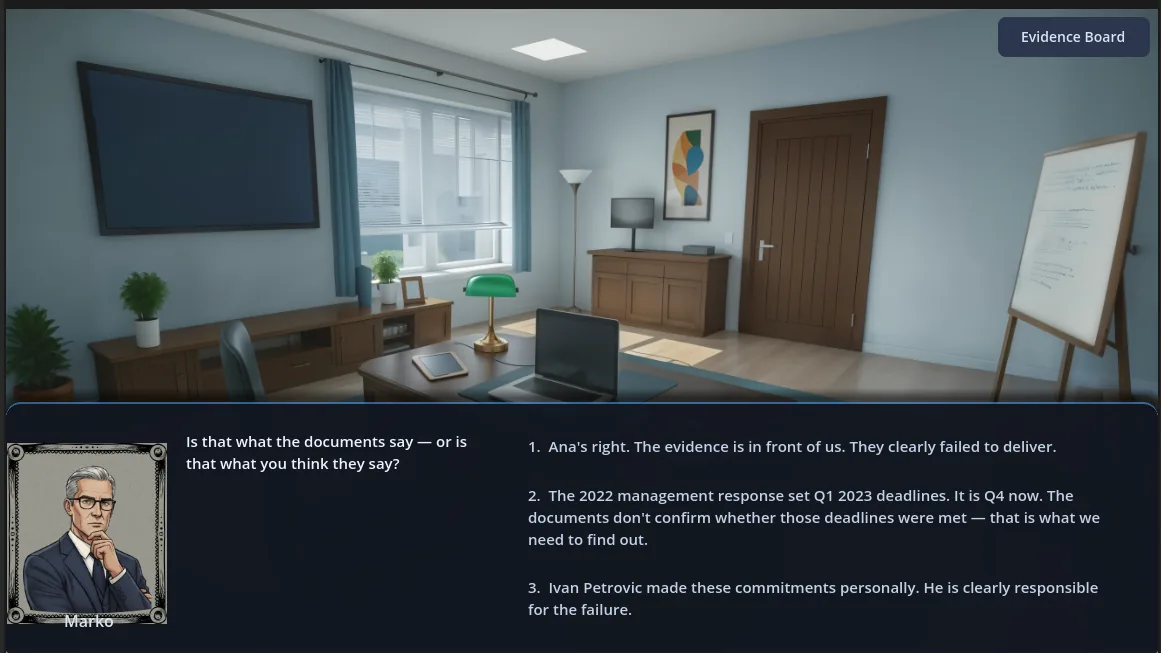
Scenario Studio is an authoring suite that lets instructional designers build branching, evidence-driven training simulations — the kind you usually can’t build in Articulate or H5P without writing code — and ship them to any SCORM-compliant LMS.
In daily use. Two worked examples on the road: Alpha Audit ships as a bundled four-act demo (~4 hours of content), and Northern Light is the first public release — a serious game on itch.io about a Dutch ministry decision. The cover image above is the Studio editing one of Northern Light’s minigames; the Studio is the workshop, Northern Light is what comes out of it.
Mainstream e-learning tools top out at shallow branching: click an avatar, pick from three answers, get a score. They can’t model the thing that actually matters in workplace judgement training — do I have enough evidence yet, and is it the right kind?
The gap: a tool that’s authorable by an instructional designer, runtime-rich enough for serious games, and deliverable through any LMS via SCORM.
A Godot 4 project with two halves.
A playable scenario is composed from Godot Resources (.tres data files), driven by a small set of engine systems:
ScenarioRunner autoload tracks the current node, character trust (-10..+10), memory flags, evidence cards, scored choices.MiniGameBase contract (setup(config) + completed(score, metadata) signal). Every mini-game is a self-contained scene droppable into any dialog node.scenario_ended, converts the fractional score to 0–100, writes cmi.core.score.raw, sets lesson_status to passed / failed against an authored threshold. HTML5 build + SCORM zip — works in SCORM Cloud, Moodle, TalentLMS.A full editor plugin (addons/scenario_editor/) that replaces .tres text-editing with form-based UI:
GraphEdit. Nodes colour-coded by role; drag-to-connect routing; BFS auto-layout; node positions persisted in the resource’s metadata.FindingTemplateData (keywords, min / max cards, feedback copy per outcome band) and EvidenceTriggerData (per-choice card emission).Ships with the engine as the reference example (examples/alpha_audit/). A full four-act internal-audit training scenario, ~4 hours of content:
Every act ends in a scored choice plus a finding-builder exercise. Trust and evidence cards carry across acts. The designed-in trap: Ana, your colleague, pushes conclusions that the evidence doesn’t support — the learning is in resisting her without dismissing her. Every data shape, every mini-game, every scoring rule was stress-tested by authoring four hours of real training content in this scenario.
A separately-published serious game that ships as a standalone build on itch.io. Northern Light: The Van Holten Light puts the player in the role of a junior Dutch ministry analyst running a cost-benefit analysis on a 19th-century lighthouse — should it stay manned, partially automate, or switch to sensors only? Five stakeholders push back on the model in a final council hearing.
Northern Light is the showcase for everything in the engine that came after Alpha Audit shipped: the Explorable Room minigame (drag-to-investigate cottages, with hotspots tied to evidence cards), the Spreadsheet minigame (a live 20-year CBA model with locked cells unlocked through fieldwork), the triangulation system (quote markers between stakeholders), and the stakeholder reactions in the council finale.
If Alpha Audit is the engine’s stress-test, Northern Light is its sales pitch. Play it on itch.io → · Full case file →
EditorPlugin with MainScreen tab and Inspector integration — same tooling as a first-party editor extension.imsmanifest.xml and bundled SCORM API wrapper produces a zip that drops into SCORM Cloud, Moodle, TalentLMS, or any compliant LMS. Tested end-to-end.This is the tool I would have wanted for the last ten years of instructional-design work. It sits between no-code author (too shallow) and custom game studio build (too expensive) — a zone every L&D team with a serious training problem ends up in, and currently has no good tool for.
.tres) — diffable, version-controllable, Inspector-editableEditorPlugin (MainScreen + Inspector integration)Engine and authoring suite in everyday use. All nine authoring tabs ship; the engine-level SCORM 1.2 bridge has been tested against SCORM Cloud end-to-end. Two examples on the road: Alpha Audit (bundled demo, four acts, full Ana arc) and Northern Light (public release on itch.io). Currently polishing: one-click SCORM packaging from inside the Export tab, a second pass on stakeholder-reaction authoring, and getting the full plugin drop-in-ready for fresh Godot projects.